



APM
An application portfolio that inventories, scores, and rationalizes itself.
Phyllis builds and extends your whole enterprise-architecture layer — any capability map, portfolio inventory or lifecycle model — grounded in your live instance and staged for your approval.


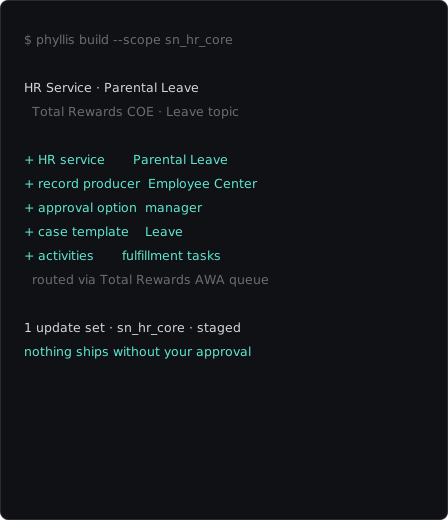
Scan the portfolio
Show me which business applications and capabilities we've modelled and where the gaps are.
 Sonnet 5 Low
 Application inventory
Stand up a business-application inventory with owners, hosting and lifecycle stage.
Sonnet 5 Low Capability map
Build a business-capability map for our lending domain, three levels deep.
Sonnet 5 Low Map apps to capabilities
Link each business application to the capabilities it supports.
Sonnet 5 Low Lifecycle scoring
Score every application by lifecycle stage and flag anything past end-of-life.
Sonnet 5 Low Technology risk
Rate our applications on technology risk and surface the high-risk ones.
Sonnet 5 Low Rationalization
Classify each app as tolerate, invest, migrate or eliminate and explain why.
Sonnet 5 Low Owner assignment
Assign an application owner to every unowned app in the portfolio.
Sonnet 5 Low Information assets
Model the customer and account information objects our lending apps rely on.
Sonnet 5 Low Value streams
Model the loan-origination value stream and the capabilities each stage needs.
Sonnet 5 Low Capability coverage
Show me capabilities with no supporting application, or three overlapping ones.
Sonnet 5 Low Portfolio reporting
Inventory today's portfolio reporting before I design a rationalization dashboard.
Sonnet 5 Low Scan the portfolio
Show me which business applications and capabilities we've modelled and where the gaps are.
Sonnet 5 Low Application inventory
Stand up a business-application inventory with owners, hosting and lifecycle stage.
Sonnet 5 Low Capability map
Build a business-capability map for our lending domain, three levels deep.
Sonnet 5 Low Map apps to capabilities
Link each business application to the capabilities it supports.
Sonnet 5 Low Lifecycle scoring
Score every application by lifecycle stage and flag anything past end-of-life.
Sonnet 5 Low Technology risk
Rate our applications on technology risk and surface the high-risk ones.
Sonnet 5 Low Rationalization
Classify each app as tolerate, invest, migrate or eliminate and explain why.
Sonnet 5 Low Owner assignment
Assign an application owner to every unowned app in the portfolio.
Sonnet 5 Low Information assets
Model the customer and account information objects our lending apps rely on.
Sonnet 5 Low Value streams
Model the loan-origination value stream and the capabilities each stage needs.
Sonnet 5 Low Capability coverage
Show me capabilities with no supporting application, or three overlapping ones.
Sonnet 5 Low Portfolio reporting
Inventory today's portfolio reporting before I design a rationalization dashboard.
Sonnet 5 Low