
Instance Health
An instance that heals on your approval.
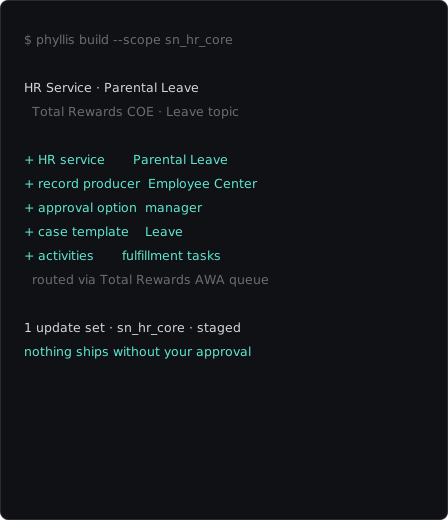
Phyllis runs hundreds of Instance Scan checks across performance, security, maintainability, UX and upgradeability — after every dev task or on demand — then writes each fix into a scoped update set, staged for your approval.


Full instance scan
Run the Instance Scan across the whole instance and show me the findings by severity.
 Sonnet 5 Low
 Slow queries
Find business rules issuing slow, un-indexed queries and show me the tables that need an index.
Sonnet 5 Low Stage indexes
Propose the indexes those queries need and stage them in a scoped update set.
Sonnet 5 Low ACL gaps
Which custom tables are missing access controls? Stage the missing ACLs for review.
Sonnet 5 Low Security sweep
Run the security checks and cite every finding to the record it came from.
Sonnet 5 Low Upgrade readiness
Which deprecated API calls — like getXMLWait — will block our next upgrade?
Sonnet 5 Low Dead code
Find dead code and orphaned artefacts nobody has touched, and stage a safe clean-up.
Sonnet 5 Low Update set hygiene
Review oversized or overlapping update sets before we cut the next release.
Sonnet 5 Low ATF coverage
Which of our critical flows have no ATF coverage? Draft the missing test suites.
Sonnet 5 Low Self-heal loop
Stage fixes for everything healable from the last scan, then re-scan once they run.
Sonnet 5 Low Scan after tasks
Re-scan after every dev task so drift is caught as it appears, not before an upgrade.
Sonnet 5 Low Health trend
Summarise instance health by category and show the trend since the last scan.
Sonnet 5 Low Full instance scan
Run the Instance Scan across the whole instance and show me the findings by severity.
Sonnet 5 Low Slow queries
Find business rules issuing slow, un-indexed queries and show me the tables that need an index.
Sonnet 5 Low Stage indexes
Propose the indexes those queries need and stage them in a scoped update set.
Sonnet 5 Low ACL gaps
Which custom tables are missing access controls? Stage the missing ACLs for review.
Sonnet 5 Low Security sweep
Run the security checks and cite every finding to the record it came from.
Sonnet 5 Low Upgrade readiness
Which deprecated API calls — like getXMLWait — will block our next upgrade?
Sonnet 5 Low Dead code
Find dead code and orphaned artefacts nobody has touched, and stage a safe clean-up.
Sonnet 5 Low Update set hygiene
Review oversized or overlapping update sets before we cut the next release.
Sonnet 5 Low ATF coverage
Which of our critical flows have no ATF coverage? Draft the missing test suites.
Sonnet 5 Low Self-heal loop
Stage fixes for everything healable from the last scan, then re-scan once they run.
Sonnet 5 Low Scan after tasks
Re-scan after every dev task so drift is caught as it appears, not before an upgrade.
Sonnet 5 Low Health trend
Summarise instance health by category and show the trend since the last scan.
Sonnet 5 Low