







SecOps
Phishing incidents that triage, contain, and review themselves.
Phyllis builds and extends your whole security-response operation — any playbook, severity model or routing — grounded in your live instance and staged for your approval.


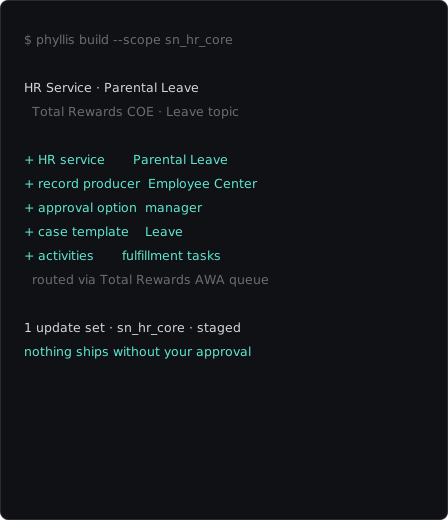
Scan SecOps setup
Show me how phishing incidents are triaged today and what severity scoring already runs.
 Sonnet 5 Low
 Severity engine
Walk me through how severity gets calculated for phishing incidents and what drives it.
Sonnet 5 Low Phishing playbook
Build a guided phishing playbook with Analysis, Contain, Eradicate and Review stages.
Sonnet 5 Low Response lifecycle
Walk me through the phishing response lifecycle and where each stage transition is defined.
Sonnet 5 Low Severity tiers
Add a High severity tier for credential-harvesting phishing.
Sonnet 5 Low Phishing intake
Turn user-reported phishing emails into incidents automatically.
Sonnet 5 Low Review routing
Route post-incident phishing reviews to the SOC lead once an incident reaches Review.
Sonnet 5 Low Runbook doc
Attach a published containment runbook to phishing tasks with the analyst steps.
Sonnet 5 Low TLP tagging
Set up a TLP:AMBER tag that restricts sensitive phishing incidents to the SOC.
Sonnet 5 Low MITRE coverage
Turn on MITRE technique intelligence and rate our phishing technique coverage.
Sonnet 5 Low Review report
Create a post-incident review template with a phishing containment-timeline section.
Sonnet 5 Low SOC reporting
Inventory today's phishing reporting before I design a SOC dashboard.
Sonnet 5 Low Scan SecOps setup
Show me how phishing incidents are triaged today and what severity scoring already runs.
Sonnet 5 Low Severity engine
Walk me through how severity gets calculated for phishing incidents and what drives it.
Sonnet 5 Low Phishing playbook
Build a guided phishing playbook with Analysis, Contain, Eradicate and Review stages.
Sonnet 5 Low Response lifecycle
Walk me through the phishing response lifecycle and where each stage transition is defined.
Sonnet 5 Low Severity tiers
Add a High severity tier for credential-harvesting phishing.
Sonnet 5 Low Phishing intake
Turn user-reported phishing emails into incidents automatically.
Sonnet 5 Low Review routing
Route post-incident phishing reviews to the SOC lead once an incident reaches Review.
Sonnet 5 Low Runbook doc
Attach a published containment runbook to phishing tasks with the analyst steps.
Sonnet 5 Low TLP tagging
Set up a TLP:AMBER tag that restricts sensitive phishing incidents to the SOC.
Sonnet 5 Low MITRE coverage
Turn on MITRE technique intelligence and rate our phishing technique coverage.
Sonnet 5 Low Review report
Create a post-incident review template with a phishing containment-timeline section.
Sonnet 5 Low SOC reporting
Inventory today's phishing reporting before I design a SOC dashboard.
Sonnet 5 Low